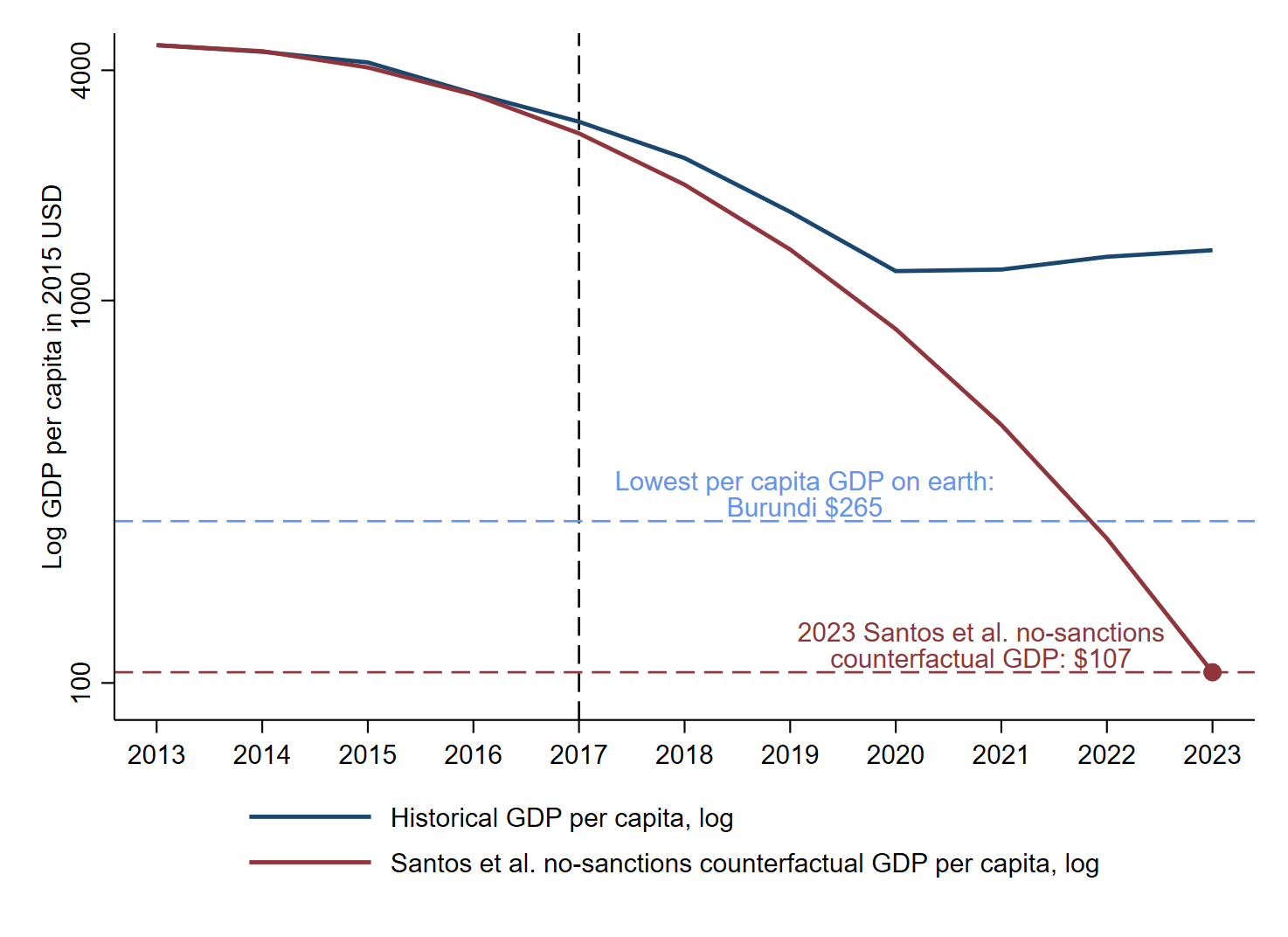
Santos, Morales-Arilla and Partipilo Cornielles (2026) claim that in the absence of sanctions Venezuela’s rate of contraction would have accelerated by approximately 6 percentage points a year. Their projections imply an implausible 98% decline in GDP in a non-sanctions scenario. This would have caused Venezuela’s per capita GDP in the absence of sanctions to fall to $107, or 40% that of the poorest country on earth, a level that has never been documented for any economy in world history. Such a contraction would have been by far the largest economic collapse ever documented, similar in magnitude to that which would result from dropping 100 nuclear warheads on the country. The fact that such extreme counterfactuals are needed to support claims of welfare-enhancing sanctions serves to demonstrate their implausibility.
The current working paper, which forms part of a broader research agenda on the human consequences of economic sanctions, dissects the claims of Santos et al. (2026), showing how their results stem from an implausible counterfactual. It also addresses other problematic features of their approach, such as reliance on a poorly executed synthetic controls exercise and failure to correct claims that have been proven false. It complements my earlier critique of their work, which you can find here.

