El 23 de marzo de 2023, el Juez Leonard Stark de la Corte Distrital de Delaware emitió una orden determinando que el Gobierno Interino de Venezuela encabezado por Juan Guaidó había ejercido control extensivo sobre PDVSA, lo que permitía que los acreedores de Venezuela ejerciesen acciones de embargo sobre las acciones de la casa matriz de Citgo. Con el objetivo de contribuir a la discusión pública, aquí proveemos una traducción al español de la opinión del Juez Stark.
Do politicians target the benefits of social programs to party loyalists or to swing voters? Traditional tests of this question are clouded by an identification problem caused by the simultaneity of politician and voter choices to participate in the exchange of assistance for votes. I use the holding of an unanticipated repeat gubernatorial election in the Venezuelan state of Barinas in 2022 as a natural experiment to identify the effects of elections on the distribution of government assistance. I estimate that the holding of the election led to an increase in the probability of voters in Barinas receiving food packages in comparison with the control group of voters in the state of Apure. I also find that moderate opposition and third-party voters received larger increases in food benefits. These results are consistent with the predictions of spatial models, according to which elections lead governments to direct more benefits to swing voters instead of core supporters. The findings illustrate why investigation of cross-sectional correlations is insufficient to test the implications of theories of voting if it is not accompanied by a clear identification strategy to help isolate the source of the underlying shocks.
How much have sanctions, and other politically induced restrictions on economic activity, affected the Venezuelan economy? How much of the country’s decline can be attributed to these causes, as opposed to the more standard causes of poor policies and external shocks? In this paper I offer a quantification of the effect of alternative causes. The bottom line is that around half of the country’s economic contraction between 2012 and 2020 can be explained as a result of sanctions and other politically induced restrictions such as the withdrawal of government recognition.
On July 3, 2019, the opposition-appointed Office of the Special Attorney General of Venezuela published a document outlining the principles for the country’s eventual debt restructuring. On March 23, 2023, Delaware District Court Judge Leonard Stark cited this document as proof of the lack of appropriate separation between the management of the country’s oil industry and the interim government, serving as the basis for the decision to allow Venezuela creditors to seek orders to attach CITGO. In this post I reproduce the comments that I published just after the publication of the opposition’s guidelines, arguing that the promise to give different creditors of the Venezuelan state equal treatment was highly problematic and could cause legal problems down the road.
This article reviews recent advances in addressing empirical identification issues in cross-country and country-level studies and their implications for the identification of the effectiveness and consequences of economic sanctions. I argue that, given the difficulties in assessing causal relationships in cross-national data, country-level case studies can serve as a useful and informative complement to cross-national regression studies. However, I also warn that case studies pose a set of additional potential empirical pitfalls which can obfuscate rather than clarify the identification of causal mechanisms at work. Therefore, the most sensible way to read case study evidence is as a complement rather than as a substitute to cross-national research.
We revisit the results of Equipo Anova (2021), who claim to find evidence of an improvement in Venezuelan imports of food and medicines associated with the adoption of U.S. financial sanctions towards Venezuela in 2017. We show that their results are consequence of data coding errors and questionable methodological choices, including the use an unreasonable functional form that implies a counterfactual of negative imports in the absence of sanctions, the omission of data accounting for four-fifths of the country’s food imports at the time of sanctions and incorrect application of regression discontinuity methods. Once these errors are corrected, the evidence of a significant improvement in the level and rate of change in imports of essentials disappears.
Francisco Rodríguez[1] Josef Korbel School of International Studies University of Denver
En los últimos días, el gobierno estadounidense autorizó a Chevron Corporation vender petróleo venezolano en los mercados de EEUU, pero le prohibió realizar pagos de impuestos y regalías al gobierno venezolano. Argumentamos que la restricción de estos pagos es simbólica porque los pasivos fiscales no recaen en Chevron, sino en las empresas mixtas en las que Chevron es un socio minoritario y cuyas decisiones no puede controlar. Además, mostramos que mientras la recuperación del acceso a los mercados estadounidenses permita a las empresas mixtas de Chevron aumentar los niveles de producción, el gobierno de Maduro recibirá flujos adicionales de divisas que puede utilizar a voluntad. Este resultado se mantiene independientemente de si el incremento de los ingresos se utiliza para reducir los atrasos de la deuda de PDVSA con Chevron.
El 26 de noviembre, la Oficina de Control de Activos Extranjeros del Departamento del Tesoro publicó una licencia que permite a Chevron aumentar significativamente el alcance de sus operaciones en Venezuela. Hasta ese momento, Chevron – la única empresa estadounidense directamente involucrada en la extracción y venta de petróleo venezolano – se había visto restringida a realizar las actividades necesarias para mantener o cerrar operaciones esenciales, pero se le prohibía producir o vender petróleo venezolano. La nueva licencia -denominada Licencia General de Venezuela No. 41 en la nomenclatura OFAC – ahora permite transacciones relacionadas con la producción, extracción y venta de petróleo venezolano a los Estados Unidos, así como la compra e importación a Venezuela de los insumos necesarios para llevar a cabo estas actividades.
Sin embargo, la Licencia General 41 también prohíbe explícitamente el pago de impuestos o regalías al Gobierno de Venezuela o el pago de dividendos a cualquier entidad propiedad de la compañía petrolera nacional venezolana, Petróleos de Venezuela, SA (PDVSA). El Departamento del Tesoro de EE. UU. publicó un comunicado de prensa en el que afirma que la autorización “evita que PdVSA reciba ganancias de las ventas de petróleo de Chevron”. Un funcionario de la administración de Biden dijo al New York Times que, en lugar de pagar impuestos y regalías, las ganancias obtenidas se destinarían al pago de la deuda del gobierno a Chevron.
Argumentamos que las declaraciones que afirman que la administración de Maduro no recibirá ingresos de las ventas de petróleo permitidas por la Licencia General 41 son objetivamente incorrectas o muy engañosas. Además, la caracterización errónea por parte del gobierno de EE. UU. de las consecuencias para las cuentas fiscales venezolanas del otorgamiento de esta licencia es un serio impedimento para el diseño de los mecanismos de rendición de cuentas necesarios para garantizar que los fondos obtenidos por Venezuela como consecuencia de las sanciones se utilicen para atender la emergencia humanitaria de Venezuela y no terminen perdidos por la corrupción o fortaleciendo el aparato represivo del estado venezolano.
¿A QUIÉN Y QUÉ RESTRINGE LA LICENCIA GENERAL 41?
La Oficina de Control de Activos Extranjeros (OFAC, por sus siglas en inglés) de EE. UU. emite regularmente licencias que permiten ciertas actividades que estarían restringidas por sus decisiones de sanciones anteriores. La decisión de sancionar – o, en el lenguaje legal preciso, bloquear – a ciertas entidades generalmente emana directa o indirectamente de órdenes ejecutivas emitidas por la presidencia de los EE. UU. En el caso de Venezuela, entre 2015 y 2019 se emitieron siete órdenes ejecutivas y 240 personas y entidades fueron incluidas en la lista de Nacionales Especialmente Designados (SDN, por sus siglas en inglés) de la OFAC. Es importante destacar que el 28 de enero de 2019, la OFAC anunció que agregaría a PDVSA – que tiene un monopolio constitucional sobre la extracción y venta de petróleo venezolano – a la lista SDN, de modo que prohibió cualquier transacción entre entidades estadounidenses y el sector petrolero venezolano.
Las órdenes ejecutivas que sirven de base para estas designaciones se basan en la autoridad otorgada al presidente de los EE. UU. a través de la Ley de Poderes Económicos de Emergencia Internacional de 1977. Esta ley, que tiene su origen en la legislación de la era de la Primera Guerra Mundial para prohibir a las entidades estadounidenses comerciar con adversarios militares de EE. UU., autoriza al presidente a “bloquear y prohibir todas las transacciones de bienes e intereses en bienes” de entidades designadas “si tales bienes o intereses en bienes están en los Estados Unidos, vienen dentro de los Estados Unidos, o están o vienen dentro la posesión o el control de una persona de los Estados Unidos.”
Las afirmaciones de que Maduro no recibirá ingresos por las ventas de petróleo permitidas por la licencia de Chevron son incorrectas o fuertemente engañosas.
La idea fundamental detrás de la autoridad del presidente para sancionar es que, si bien EE. UU. no tiene jurisdicción para impedir que los actores no estadounidenses hagan nada fuera de su territorio, puede prohibir que sus ciudadanos participen en transacciones con entidades que cree que están actuando en forma contraria a los intereses de seguridad nacional de EE.UU. Tengamos en cuenta que para que el poder ejecutivo invoque estos poderes, primero debe argumentar que las acciones de estos actores implican una “amenaza inusual y extraordinaria” para la seguridad nacional, económica o para la política exterior de los EE. UU. y declarar una emergencia nacional para hacer frente a esa amenaza. El presidente Obama emitió esa declaración con respecto a Venezuela en marzo de 2015, y todas las administraciones posteriores la han extendido por intervalos anuales.
En otras palabras, el poder del Departamento del Tesoro para sancionar a entidades no estadounidenses emana del poder de la presidencia para restringir las transacciones económicas de personas estadounidenses, ya sean empresas o individuos, cuando existen suficientes razones de política exterior para hacerlo. En el pasado, las administraciones estadounidenses han adoptado un criterio relativamente laxo para definir lo que constituye una emergencia nacional a los efectos de invocar esta autoridad, lo que le ha permitido imponer sanciones a una amplia gama de entidades extranjeras. El Departamento del Tesoro de EE. UU. enumera actualmente 38 programas de sanciones activos, la mayoría de los cuales se centran en países específicos o conflictos internacionales.
Cuando una entidad está incluida en la lista SDN, todas las personas estadounidenses tienen prohibido realizar transacciones con esa entidad. Esto significa, por ejemplo, que todas las cuentas bancarias de esa entidad en una institución financiera de EE. UU. se congelan de inmediato – ya que ningún banco puede procesar una transacción para un SDN a menos que reciba una licencia OFAC que le permita hacerlo. Tenga en cuenta que este no es un proceso judicial en el que se acusa al Nacional Especialmente Designado de violar la ley (aunque la presunción de que lo hizo puede haber llevado a la imposición de las sanciones). Por lo tanto, los bienes en cuestión continúan perteneciendo a la entidad sancionada. Sin embargo, la entidad sancionada no puede usar estos activos de manera significativa mientras las sanciones estén vigentes.
La designación de PDVSA por parte de los EE. UU. en 2019 implicaba, por lo tanto, que las entidades estadounidenses como Chevron tenían prohibido hacer negocios con PDVSA o sus filiales. Debido a una disposición conocida como regla del 50% de la OFAC, eso también significa que no podría hacer negocios con ninguna entidad en la que PDVSA tenga una participación del 50% o más. Eso incluye las empresas mixtas con PDVSA en las que Chevron es socio minoritario, Petropiar, Petroboscan, Petroindependiente y Petroindependencia (que en adelante llamaremos las empresas mixtas de Chevron).
En ausencia de una licencia, Chevron no podría realizar ninguna transacción financiera relacionada con estas empresas mixtas. Además, las empresas mixtas de Chevron no pueden utilizar el sistema financiero estadounidense para realizar ninguna transacción. Pero esto no significa que las empresas mixtas de Chevron no puedan producir petróleo. Por el contrario, las empresas mixtas de Chevron han seguido bombeando alrededor de 100 mil barriles diarios de petróleo a pesar de estar sancionadas. Esto se debe a que EE. UU. no tiene autoridad legal o real para impedir que una empresa de propiedad venezolana produzca petróleo en Venezuela y lo venda fuera de EE. UU. Dado que el comercio fuera de los EE. UU. cae fuera de su jurisdicción, lo más que puede hacer el gobierno de los EE. UU. es prohibir que las empresas propiedad de sus nacionales participen activamente en ese comercio. Sin embargo, dado que Chevron es un socio minoritario en sus empresas mixtas y no tiene poder para detener la decisión de la empresa de producir o vender petróleo, no se le puede acusar de haber hecho nada para hacer posible estas ventas y, por lo tanto, no se le puede encontrar en violación de sanciones debido a estas ventas. Y, en caso de que quedase alguna duda, las licencias anteriores permitieron a Chevron realizar transacciones necesarias para el “mantenimiento limitado de operaciones, contratos u otros acuerdos esenciales” para preservar sus activos en Venezuela, lo que implica que no tenía la obligación de renunciar a sus acciones en las empresas mixtas ni a su derecho de recibir su parte de las ganancias de estas ventas.
Exactamente por las mismas razones, la disposición de la Licencia General 41 que prohíbe el “pago de cualquier impuesto y regalías al Gobierno de Venezuela” es completamente ineficaz. Chevron no paga impuestos sobre la renta ni regalías al gobierno venezolano porque Chevron no produce petróleo en Venezuela. Son las empresas mixtas en las que Chevron es socio minoritario las que producen el petróleo y pagan impuestos y regalías al gobierno de Venezuela y dividendos a PDVSA. Chevron no tiene poder para detener los pagos realizados por las empresas mixtas en las que es socio minoritario porque estas decisiones las toman las juntas directivas de las empresas mixtas designadas por el accionista mayoritario, PDVSA – al igual que Chevron no tiene poder para detener que estas empresas mixtas produzcan petróleo en Venezuela. Y EE. UU. no tiene la autoridad ni el poder para impedir que los directorios de las empresas mixtas realicen los pagos de impuestos y regalías que están obligados a realizar de acuerdo con la ley venezolana.
¿QUIÉN RECIBE EL DINERO?
Según la ley venezolana, cada barril de petróleo producido en Venezuela está sujeto a un pago de regalías del 20% al 33% y a un impuesto sobre la renta del 50%. Estos pagos son adeudados por las empresas que realizan la producción, es decir, las empresas mixtas como Petropiar. Por lo tanto, para responder a la pregunta de si la Licencia General 41 genera un aumento en los ingresos que recibe el gobierno de Maduro, lo que tenemos que responder es si conducirá a un aumento en los niveles de producción o en las ganancias de empresas mixtas como Petropiar. (De ahora en adelante, usaremos Petropiar como ejemplo a través del cual ilustramos los mecanismos en funcionamiento para todas las empresas mixtas).
La respuesta obvia es sí. La razón es simple: si aprovechar las autorizaciones de la licencia no redundara en mayores ganancias para Petropiar, entonces no habría razón para que el gobierno de Maduro lo hiciera. Maduro siempre tiene el poder de ordenar a la empresa mixta que no venda petróleo en EE. UU., incluso si la licencia lo permite. De modo que, si Maduro ordena al directorio de Petropiar que venda petróleo a Chevron para que Chevron pueda revenderlo en los EE. UU., entonces debe ser porque esto genera mayores niveles de producción y ganancias para Petropiar. (Esto es lo que los economistas llamamos un argumento de preferencia revelada: si ves a alguien haciendo algo, generalmente significa que esa persona cree que hacerlo es para su beneficio).
EE.UU. no tiene ni la autoridad ni el poder para impedir que las juntas directivas de las empresas mixtas paguen los impuestos que están obligadas a pagar por la ley venezolana.
Además, existe evidencia más que abundante de que las sanciones estadounidenses han tenido un efecto en la producción petrolera venezolana, lo que implica que revertir estas sanciones, aunque solo sea parcialmente, debería llevar a la producción petrolera venezolana a experimentar cierta recuperación. De hecho, esa es la única razón por la que esta decisión tiene sentido desde el punto de vista de la administración de Biden. El acceso a los mercados petroleros de EE. UU. le permite a Venezuela aumentar la producción de petróleo porque parte de la disminución de su producción se debió a la falta de clientes dispuestos a comprar petróleo venezolano dada la amenaza de las llamadas sanciones secundarias (la capacidad de EE. UU. de sancionar a las empresas de otros países que compran petróleo venezolano). Adicionalmente, la incapacidad de Venezuela para obtener insumos clave, incluidos los diluyentes, ha sido un lastre significativo para su capacidad productiva, y la licencia de Chevron autoriza explícitamente a la empresa a importar estos diluyentes a Venezuela para la operación de sus empresas mixtas.
Sin embargo, la licencia de Chevron también le otorga a la empresa el derecho exclusivo de vender petróleo venezolano en los Estados Unidos. Entonces, si se impide que todo el flujo de ingresos de Chevron termine como regalías o impuestos para el estado venezolano, y los ingresos adicionales que obtienen las empresas mixtas solo provienen de las ventas a los EE. UU., ¿cómo es que Venezuela puede convertir estos pagos en ingresos fiscales adicionales?
Para entender la respuesta a esta pregunta conviente trabajar con un sencillo ejemplo numérico. Primero, recordemos una serie de puntos importantes. Uno es que Chevron nunca deberá regalías o impuestos a Venezuela; Petropiar sí. El segundo es que, como en el caso de cualquier accionista, los beneficios económicos de Chevron por participar en Petropiar son su parte de los beneficios obtenidos por la empresa. Por lo tanto, cualquier ganancia que Chevron reciba del acuerdo es el resultado de que Petropiar obtenga mayores ingresos después de pagar impuestos y regalías, así como en otros costes.
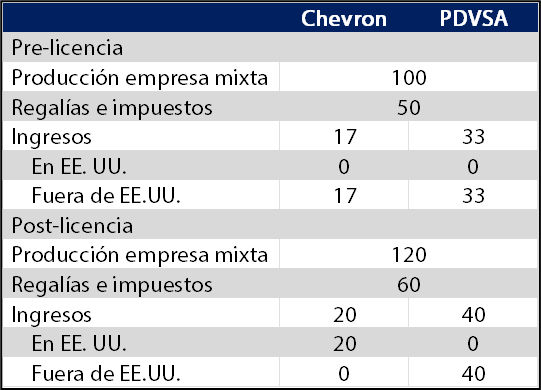
Para simplificar los cálculos, supondremos que el Estado venezolano se queda con el 50% de todos los ingresos por ventas en concepto de regalías e impuestos, y que antes de la concesión de la licencia, Petropiar está produciendo 100 barriles al día. También asumimos que en nuestros cálculos no hay costes de producción (alternativamente, se puede pensar en estas cifras como el valor neto de la producción de un coste de producción constante por barril). Entonces la empresa mixta tendrá unos beneficios después de impuestos y regalías iguales al valor de 50 barriles diarios, de los cuales un tercio (17 barriles) corresponderá a Chevron y los dos tercios restantes (33 barriles) a PDVSA.[2] Dado que estos cálculos reflejan la distribución de los ingresos antes de la emisión de la licencia, entonces todos estos ingresos se generan a partir de las ventas en mercados no estadounidenses, como China. Estas cifras se muestran en el panel superior de la Tabla 1.
Ahora, consideremos cómo cambia esto con la Licencia General 41. Supongamos que la producción de Petropiar sube a 120 barriles diarios como resultado de la apertura de estos nuevos mercados, es decir, que la empresa puede colocar a través de Chevron 20 barriles adicionales en los mercados estadounidenses. La empresa mixta pagará ahora la mitad de esa cantidad al Estado venezolano, y la otra mitad se repartirá entre Chevron y PDVSA en proporción a sus participaciones en la empresa. Esto significa que Chevron recibirá 20 barriles diarios de ganancias, y PDVSA el equivalente a 40 barriles diarios, y los 60 restantes se destinarán a pagar regalías y dividendos. Pero nótese que los 20 barriles de Chevron equivalen al aumento de las ventas de Petropiar por su capacidad de vender en el mercado estadounidense.
Recordemos que Chevron es la única que puede vender petróleo en EEUU. Así que lo que sucederá en la práctica es que Petropiar le dará a Chevron estos 20 barriles y Chevron los venderá en los EE.UU. quedándose con todo el producto de la venta. El valor de estos 20 barriles es exactamente lo que Petropiar tiene que dar a Chevron para pagar su beneficio en toda la empresa. Chevron venderá este petróleo en EE.UU., retendrá el producto en sus cuentas y afirmará que cumple plenamente con las sanciones estadounidenses. Los políticos estadounidenses afirmarán que ni un solo dólar de las ventas de Chevron en EE.UU. va a financiar el régimen de Maduro.
Sin embargo, consideren lo que ha sucedido con los ingresos del gobierno. Por un lado, los pagos de impuestos y regalías aumentaron en 10 barriles (de 50 a 60); por otro, las ganancias de PDVSA después de impuestos y regalías aumentaron en 7 (de 33 a 40). En total, el Estado venezolano aumentó sus ingresos en 17, lo que representa el total de lo que se lleva Venezuela (50% de toda la producción más dos tercios de los beneficios) del aumento de 20 barriles en la producción de petróleo. Aunque los funcionarios estadounidenses afirman que Venezuela no recibe ni un centavo, la realidad es que Maduro se queda con 83 centavos de cada dólar adicional generado como resultado de la apertura de los mercados petroleros estadounidenses al petróleo venezolano.
TABLA 1: DISTRIBUCIÓN DE LOS INGRESOS DE LAS VENTAS Y LOS BENEFICIOS DE LA EMPRESA MIXTA, CASO BASE
Este sencillo ejemplo ilustra cómo, debido a la fungibilidad del dinero, no importa realmente a dónde “van” los ingresos de las ventas en EEUU. De hecho, no es difícil para PDVSA evitar tocar los ingresos generados por las ventas en EE.UU. y seguir ganando más dinero con el acuerdo. Esto se debe a que PDVSA puede permitir que Chevron se quede con la totalidad de los ingresos de sus ventas en EE.UU. y, al mismo tiempo, quedarse con una mayor parte de los ingresos de las ventas de Petropiar fuera de EE.UU. Y como Chevron, como accionista, sólo tiene derecho a una parte determinada de los beneficios de la empresa, no tiene más remedio que aceptar que si no va a entregar a PDVSA los ingresos de sus ventas en Estados Unidos, debe permitir que PDVSA se quede con la mayor parte de los ingresos de las ventas fuera de Estados Unidos.
Impedir que Chevron transfiera los ingresos de las ventas de EE.UU. a Venezuela no impide que Maduro reciba más ingresos como resultado del acuerdo.
¿Cómo cambia esto si el producto de las ventas a EE.UU. se aplica únicamente al pago de la deuda que PDVSA ha acumulado con Chevron, como han informado algunos medios de comunicación? Nótese que la Licencia General 41 no menciona en ningún momento el pago de la deuda, sin embargo, se cree que una disposición que especifica que el producto de las ventas de EE.UU. se aplique únicamente al pago de la deuda podría haber sido incluida en el contrato que se sabe que Chevron negoció con el gobierno de Maduro y que no se ha hecho público.
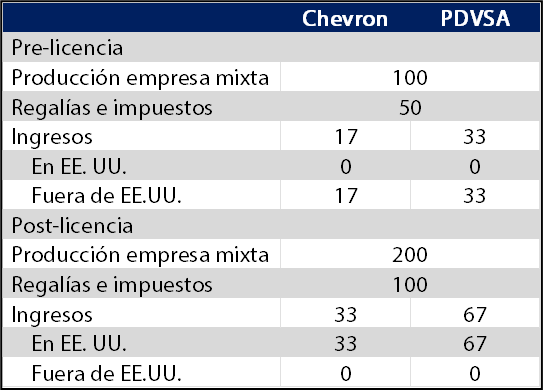
La respuesta, ilustrada en el cuadro 2, es que no cambia mucho. Obsérvese que en nuestro ejemplo anterior los 20 barriles vendidos por Chevron en el mercado estadounidense eran lo justo para cubrir su cuota de ganancias. Si Chevron intentara utilizar los ingresos para reducir la cantidad que le debe PDVSA, entonces tendría que vender más petróleo en los mercados estadounidenses. Así que supongamos ahora que en lugar de aumentar un 20%, la producción de Petropiar como resultado del acuerdo se duplica a 200 barriles. Como Chevron es la única que puede vender en los mercados estadounidenses, esto significa que debe vender todos los 100 barriles adicionales en Estados Unidos. Pero esto superaría con creces la cuota de ingresos de Chevron en la nueva situación, que es de sólo 33 barriles. Para cumplir con el acuerdo y la Licencia General 41, Chevron utiliza ahora los ingresos de los 67 barriles restantes, que pertenecen a PDVSA, para reducir la deuda de PDVSA con Chevron. Así, Chevron mantiene en sus cuentas el producto de los 100 barriles vendidos en Estados Unidos y PDVSA reduce su pasivo con Chevron en el valor de mercado de los 67 barriles.
TABLA 2: DISTRIBUCIÓN DE LOS INGRESOS DE LAS VENTAS Y LOS BENEFICIOS DE LA EMPRESA MIXTA, CASO DE REEMBOLSO DE LA DEUDA
En un nivel, el resultado es exactamente el mismo: el Estado venezolano sigue obteniendo el 83% de todas las ventas, salvo que está aplicando gran parte de esos ingresos a reducir sus pasivos en lugar de aumentar sus activos. Pero si nos centramos sólo en el flujo de caja derivado de la operación – suponiendo que la reducción de pasivos no beneficia a Maduro en ningún sentido significativo – sigue siendo el caso que las ganancias del Estado han aumentado de 83 a 167 barriles, y que aunque haya aceptado utilizar 67 de esos barriles para reducir la deuda de PDVSA, Maduro todavía ha visto aumentar su flujo de caja positivo de 83 a 100. La razón, una vez más, es que si Maduro acepta que todos los ingresos de las ventas en EE.UU. se utilicen para reducir su deuda con Chevron, adquiere el derecho de utilizar todos los ingresos de las ventas fuera de EE.UU. para pagar mayores regalías e impuestos.
La conclusión es que impedir que Chevron transfiera sus ingresos de las ventas en EE.UU. a Venezuela no impide que el gobierno venezolano reciba más ingresos como resultado del acuerdo. Esto es así porque lo importante para determinar la recaudación fiscal de Venezuela no es cuánto vende Chevron en Estados Unidos, sino cuánto vende Petropiar en su conjunto. No hay manera de abrir los mercados a las empresas petroleras controladas por el gobierno de Venezuela sin permitirles generar ingresos adicionales, ingresos en los que Maduro puede asegurar una mayor participación, aunque se comprometa a no tocar ni un centavo de los flujos generados en Estados Unidos.
Sin embargo, el hecho de que el esquema permita a Maduro obtener beneficios fiscales no implica necesariamente que le dé todo lo que quiere. Tomando prestado el ejemplo de la Tabla 2, podríamos especular que el gobierno puede ver como demasiado poco un aumento en su flujo de caja de sólo el valor de 17 barriles, cuando la nación está exportando 100 barriles más a los Estados Unidos. De hecho, según algunos informes de prensa, el gobierno y Chevron habían negociado un acuerdo en el que sólo un tercio de los barriles vendidos por Chevron en nombre de PDVSA se utilizaría para pagar la deuda, un tercio se reinvertiría en la empresa y un tercio se pagaría a PDVSA para recuperar los costes operativos.
El problema de la aplicación del acuerdo en la actualidad no tiene nada que ver con el pago de impuestos – que, como explicamos, no están sujetos a la jurisdicción estadounidense – sino con la capacidad de Chevron para realizar las transferencias financieras necesarias a PDVSA para recuperar los gastos operativos. Recordemos que la Licencia General 41 autoriza transacciones que son “ordinariamente incidentes y necesarias” para las actividades que están explícitamente autorizadas, como la extracción y venta de petróleo. La cuestión es si el reembolso de los gastos operativos de PDVSA es normalmente incidental y necesario para la producción y venta de petróleo venezolano. Probablemente dependerá de la OFAC aclarar si estos pagos se consideran una transacción permitida por estos motivos. Obsérvese que este problema no se plantea con el reembolso de las deudas de PDVSA a Chevron porque la OFAC considera que el reembolso de la deuda es una transacción bloqueada cuando está implicada una institución financiera, lo que generalmente no es el caso en el pago de los atrasos comerciales.
LA DESAPARICIÓN DE LA RENDICIÓN DE CUENTAS
Desde que se impusieron las sanciones petroleras a Venezuela en 2019, varias voces han reclamado la promulgación de un acuerdo de petróleo por bienes esenciales que permita a Venezuela recuperar el acceso a los mercados petroleros internacionales con la condición de que se diseñen mecanismos institucionales que garanticen que los ingresos de estas ventas se destinen a la compra de bienes e insumos necesarios para atender la crisis humanitaria de Venezuela, sujetos a la supervisión internacional bajo altos estándares de transparencia. Al menos tres propuestas bien diseñadas en este sentido fueron publicadas por organizaciones no gubernamentales: Oil for Venezuela (que dirijo), el Boston Group y el Grupo de Trabajo sobre Venezuela del Atlantic Council.
Curiosamente, el espíritu de estas propuestas parece haber sido incorporado en el Acuerdo Social suscrito por el gobierno de Maduro y una coalición opositora para utilizar fondos pertenecientes al Estado venezolano y hasta ahora bloqueados como consecuencia de las sanciones u otras medidas de estatuismo económico como el no reconocimiento del gobierno de Maduro por parte de los Estados en los que se encuentran esos fondos.
La conveniencia política puede haber superado la preocupación por el bienestar de los venezolanos, que hasta hace poco había desempeñado un papel tan importante en el discurso de la política exterior de Estados Unidos.
En cambio, la licencia Chevron no contempla ninguno de esos mecanismos de rendición de cuentas. Más bien, como hemos mostrado en esta nota, genera ingresos adicionales en efectivo que el régimen de Maduro podrá utilizar a su antojo, y que fácilmente podrían terminar desviados a la corrupción o utilizados para financiar el aparato represivo del Estado.
En su libro seminal de 1989 sobre la economía política de la política comercial, Stephen Magee, William Brock y Leslie Young desarrollaron la teoría de la “ofuscación óptima”, que postulaba que los responsables políticos diseñarían políticas destinadas a transferir rentas a grupos de intereses especiales mientras las camuflaban alegando que pretendían abordar auténticos problemas de distribución o eficiencia. Dado que es poco probable que los votantes reaccionen de forma amable cuando se les dice de forma transparente que una política ha sido diseñada para favorecer intereses especiales, los responsables políticos tratarán de idear argumentos que, a pesar de ser falsos o engañosos, puedan parecer plausibles a un público que carece de la experiencia o el interés necesarios para discernir los verdaderos efectos de la política. Parece claro que las autoridades estadounidenses han estado interesadas en aprovechar fuentes adicionales de suministro de petróleo para compensar el efecto de las sanciones a Rusia y ayudar a contener los precios de los combustibles. También es evidente que el deseo de no enemistarse con grupos de votantes clave, incluidas las diásporas conservadoras cubana y venezolana, ha influido profundamente en la presentación de la política de Estados Unidos hacia Venezuela. Así, la conveniencia política puede haber superado la preocupación por el bienestar de los venezolanos que hasta hace poco había desempeñado un papel tan importante en el discurso de la política exterior de la administración.
NOTAS
[1] Escuela de Estudios Internacionales Josef Korbel, Universidad de Denver. Correo electrónico: Francisco.Rodríguez4@du.edu. Agradezco a Jacques Bentata, Giancarlo Bravo, Luisa García y Camille Rodríguez por su excelente asistencia en la investigación. Aunque soy el único autor de este artículo y asumo la responsabilidad por cualquier error, también deseo reconocer que esta investigación es el resultado de una empresa colectiva enriquecida por las contribuciones, ideas y puntos de vista de colegas, estudiantes y personal. Para reconocer y hacer justicia a sus contribuciones, escribo esta nota en primera persona del plural.
Francisco Rodríguez[1] Josef Korbel School of International Studies University of Denver
In recent days, the US government authorized Chevron Corporation to resell Venezuelan oil in US markets but barred it from making tax and royalty payments to the Venezuelan state. We argue that the restriction on these payments is symbolic because fiscal liabilities are incurred not by Chevron but by the joint ventures in which Chevron is a minority partner and whose decisions it is unable to control. Furthermore, we show that as long as regaining access to US markets enables Chevron joint ventures to increase production levels, the Maduro government will receive additional hard currency revenue flows which it can use at will. This result holds regardless of whether incremental revenues are used to reduce PDVSA’s debt arrears with Chevron.
On November 26, the Treasury Department’s Office of Foreign Assets Control published a license allowing Chevron to significantly increase the scope of its operations in Venezuela. Up until that time, Chevron – the sole American company directly involved in extracting and selling Venezuelan oil – had been restricted to performing activities necessary for maintaining or winding down essential operation but was barred from producing or selling Venezuelan oil. The new license – labeled Venezuela General License No. 41 in the OFAC nomenclature – now allows transactions related to the production, lifting and sale of Venezuelan oil into the United States, as well as the purchase and importation into Venezuela of the intermediate inputs needed to carry out these activities.
However, General License 41 also explicitly bars the payment of any taxes or royalties to the Government of Venezuela or the payment of dividends to any entity owned by the Venezuelan national oil company, Petróleos de Venezuela, SA (PDVSA). The US Treasury Department published a press statement claiming that the authorization “prevents PdVSA from receiving profits from the oil sales by Chevron.” A Biden administration official told the New York Times that instead of going to pay taxes and royalties, profits earned would go to the repayment of government debt to Chevron.
We argue that statements claiming that the Maduro administration will not receive revenues from the oil sales allowed by General License 41 are either factually incorrect or highly misleading. Furthermore, the US government’s mischaracterization of consequences for Venezuelan fiscal accounts of the granting of this license is a serious impediment to the design of the mechanisms of accountability necessary to ensure that the funds obtained by Venezuela as a consequence of sanctions relief are used to attend Venezuela’s humanitarian emergency and do not end up being lost to corruption or strengthening the repressive apparatus of the Venezuelan state.
WHO AND WHAT DOES GENERAL LICENSE 41 RESTRICT?
The US Office of Foreign Assets Control (OFAC) regularly issues licenses permitting certain activities that would be restricted by its prior sanctions decisions. The decision to sanction – or, in the precise legal language, to block – certain entities usually emanates either directly or indirectly from executive orders issued by the US presidency. In the case of Venezuela, seven executive orders were issued between 2015 and 2019 and 240 persons and entities were included in OFAC’s list of Specially Designated Nationals (SDN). Importantly, on January 28, 2019, OFAC announced that it would add PDVSA, which holds a constitutional monopoly on the extraction and sales of Venezuelan oil, to the SDN list, therefore barring any transaction between US entities and the Venezuelan oil sector.
The executive orders that serve as basis for these designations are based on the authority granted to the US president through the International Emergency Economic Powers Act of 1977. This law, which has its origins in World War I era legislation to prohibit US entities from trading with the US’s military adversaries, authorizes the president to “block and prohibit all transactions in property and interests in property” of designated entities “if such property or interests in property are in the United States, come within the United States, or are or come within the possession or control of a United States person.”
Claims that Maduro will not receive revenues from the oil sales allowed by the Chevron license are either factually incorrect or highly misleading.
The fundamental idea behind the president’s authority to sanction is that while the US has no jurisdiction to impede non-US actors from doing anything outside of its territory, it can still bar its nationals from being involved in transactions with entities that it believes are acting in a way that is contrary to US national security interests. Note that in order for the executive branch to invoke these powers, it must first argue that the actions of these actors imply an “unusual and extraordinary threat” to US national, foreign policy or economic security and declare a national emergency to deal with that threat. President Obama issued that declaration in March 2015, and all subsequent administrations have extended it by yearly intervals.
In other words, the power of the Treasury Department to sanction non-US entities emanates from the power of the presidency to restrict the economic transactions of US persons – be they firms or individuals – when there are sufficient foreign policy reasons to do so. In the past, US administrations have adopted a relatively lax criteria to define what constitutes a national emergency for the purposes of invoking this authority, allowing it to impose sanctions on a vast array of foreign entities. The US Treasury Department currently lists 38 active sanctions programs, most of which are focused on specific countries or international conflicts.
When an entity is included in the SDN list, all US persons are prohibited from engaging in transactions with that entity. That means, for example, that all bank accounts of that entity in a US financial institution are immediately frozen – as no bank can process a transaction for an SDN unless it receives an OFAC license allowing it to do so. Note that this is not a judicial process in which the SDN is accused of violating the law (although the presumption that it did so may have led to the imposition of the sanctions). Therefore, the assets in question continue to belong to the sanctioned entity. However, the sanctioned entity cannot use these assets in any meaningful way while the sanctions are in place.
The US’s designation of PDVSA in 2019 thus implied that US entities like Chevron were prohibited from doing business with PDVSA or its controlled entities. Because of a provision known as OFAC’s 50% rule, that also means that it could not do business with any entity in which PDVSA has a stake of 50% or more. That includes the joint ventures with PDVSA in which Chevron is a minority partner, Petropiar, Petroboscan and Petroindependencia (which we call the Chevron JVs henceforth).
In the absence of a license, Chevron wouldn’t be able to carry out any financial transactions related to these JVs. Furthermore, the Chevron JVs cannot use the US financial system in order to carry out any transactions. But this doesn’t mean that the Chevron JVs can’t produce oil. On the contrary, the Chevron JVs have continued pumping around 100 thousand barrels per day of oil despite being sanctioned. This is because the US has no legal or real authority to stop a Venezuelan-owned firm from producing oil in Venezuela and selling it outside of the US. Since non-US trade falls outside of its jurisdiction, the most that the US government can do is prohibit firms owned by its nationals from actively participating in that trade. Yet since Chevron is a minority partner in its JVs and has no power to stop the firm’s decision to produce or sell oil, it cannot be accused of having done anything to make these sales possible and cannot thus be found in violation of sanctions because of these sales. And, just in case there are any doubts, prior licenses allowed Chevron to carry out transactions necessary for the “limited maintenance of essential operations, contracts or other agreements” to preserve its Venezuela assets, implying that it was under no obligation to divest from its shares in its JVs nor from its right to receive its share of earnings from these sales.
For exactly the same reasons, the provision of General License 41 prohibiting “payment of any taxes and royalties to the Government of Venezuela” is completely toothless. Chevron does no pay income taxes or royalties to the Venezuelan government because Chevron produces no oil in Venezuela. It is the JVs in which Chevron is a minority partner that produce the oil and pay taxes and royalties to the government of Venezuela and dividends to PDVSA. Chevron has no power to stop the payments made by the JVs in which it is the minority partner because these decisions are taken by the board of the JVs appointed by the majority shareholder, PDVSA – just the same as Chevron has no power to stop these JVs from producing oil in Venezuela. And the US has neither the authority nor the power to stop the boards of the JVs from making the tax and royalty payments that they are obligated to make according to Venezuelan law.
WHO GETS THE MONEY?
According to Venezuelan law, every barrel of oil produced in Venezuela is subject to a royalty payment of 20-33% and an income tax on earnings of 50%. These payments are owed by the firms carrying out the production, i.e., the JVs like Petropiar. Therefore, to answer the question of whether General License 41 leads to an increase in the revenues received by the Maduro government, what we have to answer is whether it will lead to an increase in the production levels or profits of JVs such as Petropiar. (From now on, we will use Petropiar as an example through which we illustrate the mechanisms at work for all the JVs).
The obvious answer is yes. The reason is simple: if taking advantage of the authorizations in the license did not lead to greater profits for Petropiar, then there would be no reason for the Maduro administration to do so. Maduro always has the power to order the JV not to sell oil in the US even if the license allows it. So if Maduro orders the Petropiar board to sell oil to Chevron so Chevron can resell it in the US, then it must be because this generates increased production levels and profits for Petropiar. (This is what we economists call a revealed preference argument: if you see someone doing something, it usually means that that person believes that doing it is to their advantage.)
The US has neither the authority nor the power to stop the boards of JVs from paying the taxes that they are obligated to pay by Venezuelan law.
Furthermore, there is more than abundant evidence that US sanctions have had an effect on Venezuelan oil production, implying that reverting these sanctions, even if only partially, should lead Venezuelan oil production to experience some recovery. In fact, that is the only reason why this decision makes sense from the standpoint of the Biden administration. Accessing US oil markets allows Venezuela to increase oil production because part of the decline of its production was caused by lack of clients willing to purchase Venezuelan oil due to the threat of so-called secondary sanctions (the US ability to sanction third-country firms purchasing Venezuelan oil), and because Venezuela’s inability to obtain key inputs including diluents has been a significant drag on its productive capacity, and the Chevron license explicitly authorizes the firm to import these diluents into Venezuela for the operation of its JVs.
However, the Chevron license also grants Chevron the exclusive right to sell Venezuelan oil in the United States. So, if all the revenue stream from Chevron is precluded from ending up as royalties or taxes to the Venezuelan state, and the additional revenue that the JVs are earning is only coming from sales to the US, how is it that Venezuela can convert these payments into additional fiscal revenues?
To understand the response to this question, it is useful to work through a simple numerical example. First, let’s recall a set of important points. One is that Chevron will never owe royalties or taxes to Venezuela; Petropiar will. The second is that, as is the case for any shareholder, Chevron’s economic benefits from participating in Petropiar are its share of the profits earned by the company. Therefore, any earnings that Chevron receives from the deal are the result of Petropiar earning higher revenues after its tax and royalty payments, as well as other costs, are incurred.
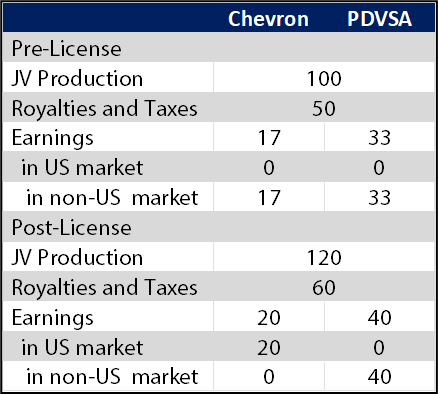
To make the math simple, we will assume that the Venezuelan state takes 50% of all sales proceeds as royalties and taxes, and that before the issuance of the license, Petropiar is producing 100 barrels per day. We also assume away in our calculations any production costs (alternatively, you can think of these numbers as the value of production net of a constant per-barrel cost of production). Then the JV will have earnings after taxes and royalties equal to the value of 50 barrels per day, of which one-third (17 barrels) will correspond to Chevron and the remaining two-thirds (33 barrels) belong to PDVSA.[2]
Because these calculations reflect the distribution of earnings before the issuance of the license, then all of these revenues are generated from sales in non-US markets such as China. These numbers are shown in the upper panel of Table 1.
Now, consider how this changes with General License 41. Let us assume that Petropiar’s production goes up to 120 barrels per day as a result of the opening of these new markets, i.e., that the firm can place through Chevron an additional 20 barrels in US markets. The JV will now pay half of that to the Venezuelan state, and the other half will be distributed among Chevron and PDVSA proportionate to their shares of the company. This means that Chevron will receive 20 barrels per day in earnings, and PDVSA the equivalent of 40 barrels per day, with the remaining 60 going to pay royalties and dividends. But note that Chevron’s 20 barrels are equivalent to the increase in Petropiar’s sales from its ability to sell in the US market.
Remember that Chevron is the only one that can sell oil in the US. So what will happen in practice is that Petropiar will give Chevron these 20 barrels and Chevron will sell them in the US keeping the whole proceeds of the sale. The value of these 20 barrels is exactly what Petropiar has to give Chevron to pay for its profit in the whole firm. Chevron will sell this oil in the US, retain the proceeds in its accounts, and claim that it is in full compliance with US sanctions. American politicians will claim that not one dollar of Chevron’s sales in the US are going to fund the Maduro regime.
Yet consider what has happened to the government take. On the one hand, tax and royalty payments rose by 10 barrels (from 50 to 60); on the other, PDVSA’s earnings after tax and royalties rose by 7 (from 33 to 40). In total, the Venezuelan state increased its revenues by 17, which represents the total Venezuelan take (50% of all production plus two-thirds of profits) of the 20 barrel increase in oil production. While US officials claim that Venezuela is not getting a dime, the reality is that Maduro is keeping 83 cents of every additional dollar generated as a result of opening up US oil markets to Venezuelan oil.
TABLE 1: DISTRIBUTION OF PROCEEDS FROM JV SALES AND EARNINGS, BASE CASE
This simple example illustrates how, because of the fungibility of money, it doesn’t really matter where the revenues of sales in the US “go.” It is, in fact, not difficult for PDVSA to avoid touching the revenues generated by US sales and still make more money from the arrangement. This is because PDVSA can allow Chevron to keep the whole proceeds from its US sales while at the same time keeping a greater share of the proceeds from Petropiar’s non-US sales. And because Chevron as a shareholder has a right only over a given share of the firm’s earnings, then it has no option but to accept that if it is not going to hand over to PDVSA the proceeds from its US sales, it must allow PDVSA to keep the bulk of the proceeds of the non-US sales.
Stopping Chevron from transferring proceeds of US sales to Venezuela does not stop Maduro from receiving more revenues as a result of the agreement.
How does this change if the proceeds of the US sales are applied only to the payment of debt that PDVSA has accumulated with Chevron, as some news media have reported? Note that General License 41 does not mention debt payments at any moment, yet it is believed to be the case that a provision specifying that the proceeds of US sales be applied solely to debt payments could have been included in the contract that Chevron is known to have negotiated with the Maduro government and which has not been made public.
The answer, illustrated in Table 2, is that it doesn’t change much. Note that in our previous example the 20 barrels sold by Chevron in the US market were just enough to cover its share of earnings. If Chevron were to try to use the proceeds to reduce the amount that PDVSA owes it, then it would have to sell more oil in US markets. So let’s now assume that instead of rising by 20 percent, Petropiar production as a result of the deal doubles to 200 barrels. Since Chevron is the only one who can sell in US markets, this means that it must be selling all of the additional 100 barrels in the US. But this would far exceed Chevron’s revenue share in the new situation, which is only 33 barrels. To comply with the agreement and General License 41, Chevron now uses the proceeds from the remaining 67 barrels, which belong to PDVSA, to reduce PDVSA’s debt with Chevron. Thus, Chevron keeps the proceeds from the 100 barrels sold in the US in its accounts and PDVSA reduces its liabilities with Chevron by the market value of 67 barrels.
TABLE 2: DISTRIBUTION OF PROCEEDS FROM JV SALES AND EARNINGS, DEBT REPAYMENT CASE
At one level, the outcome is exactly the same: the Venezuelan state is still getting 83% of all sales, except that it is applying a large part of those proceeds to reduce its liabilities rather than increase its assets. But if we focus just on the cash flow derived from the operation – assuming that reducing liabilities does not benefit Maduro in any meaningful sense – it is still the case that the fiscal take including PDVSA earnings has risen from 83 to 167 barrels, and that even though he has accepted using 67 of those barrels to reduce PDVSA’s debt, Maduro still has seen his positive cash flow increase from 83 to 100. The reason, once again, is that if Maduro accepts that all the proceeds from US sales be used to reduce his debt to Chevron, he acquires the right to use all of the proceeds from non-US sales to pay higher royalties and taxes.
The bottom line is that stopping Chevron from transferring their proceeds of US sales to Venezuela does not stop the Venezuelan government from receiving more revenues as a result of the agreement. This is because what is important to determine Venezuela’s fiscal take is not how much Chevron sells in the United States but how much Petropiar sells as a whole. There is no way to open up markets to Venezuela’s government-controlled oil firms without allowing them to generate additional revenues, revenues in which Maduro can ensure a greater participation even if he commits not to touching one penny of the flows generated in the United States.
However, the fact that the scheme allows Maduro to reap fiscal benefits does not necessarily imply that it gives him all that he wants. Borrowing from the example in Table 2, we could speculate that the government may see an increase in its cash flow of only the value of 17 barrels, when the nation is exporting 100 barrels more to the United States, as too little. In fact, according to some press reports, the government and Chevron had negotiated an agreement in which only one third of the barrels sold by Chevron on behalf of PDVSA would be used to repay debt, a third would be reinvested in the firm and a third would be paid to PDVSA to recoup operational costs.
The problem with implementation of the agreement at present has nothing to do with tax payments – which, as we explained, are not subject to US jurisdiction – but with the ability of Chevron to make the required financial transfers to PDVSA to recoup operational expenses. Recall that General License 41 authorize transactions that are “ordinarily incident and necessary” to the activities that are explicitly authorized, such as extraction and sales of oil. The question is whether reimbursing operating costs of PDVSA is ordinarily incident and necessary to the production and sale of Venezuelan oil. It will likely be up to OFAC to clarify whether these payments qualify as a permitted transaction on these grounds. Note that this problem does not arise with repayment of debts owed by PDVSA to Chevron because OFAC considers debt repayment to be a blocked transaction when a financial institution is involved, which is generally not the case in the payment of commercial arrears.
THE DEMISE OF ACCOUNTABILITY
Since oil sanctions on Venezuela were imposed in 2019, several voices have called for the enactment of an oil-for-essentials agreement that would allow Venezuela to regain access to international oil markets on the condition that institutional mechanisms be designed to ensure that the proceeds from these sales be used to purchase goods and inputs needed to address Venezuela’s humanitarian crisis subject to international monitoring under high standards of transparency. At least three well-designed proposals to this effect were published by non-governmental organizations: Oil for Venezuela (which I direct), the Boston Group and the Atlantic Council’s Venezuela Working Group.
Interestingly, the spirit of these proposals appears to have been incorporated in the Social Agreement subscribed by the Maduro government and an opposition coalition to use funds belonging to the Venezuelan state and until now blocked as a result of sanctions or other measures of economic statecraft such as the non-recognition of the Maduro government by states in which those funds are located.
In contrast, the Chevron license contemplates none of those mechanisms of accountability. Rather, as we have shown in this note, it generates additional cash revenues that the Maduro regime will be able to use at will, and that could easily end up siphoned off to corruption or used to fund the state’s repressive apparatus.
Political expediency may have trumped the concerns with the well-being of Venezuelans that until recently had played such an important role in the US’s foreign policy discourse.
Why the US government opted for this course of action is a difficult question to answer. The explanation that US policymakers did not understand or were not aware of the mechanisms described in this note does not seem credible, given the high stakes involved and the technical expertise deployed by all actors in the development of this solution, which has been negotiated over the course of several months. Rather, the explanation may seem to lie in the complex politics behind the agreement.
In their seminal 1989 book on the political economy of trade policy, Stephen Magee, William Brock and Leslie Young developed the theory of “optimal obfuscation”, which postulated that policymakers would design policies intended to transfer rents to special interest groups while camouflaging them by alleging that they intended to address genuine distributional or efficiency problems. Since voters are unlikely to react kindly to being transparently told that a policy was designed to favor special interests, policymakers will try to come up with arguments that, despite being false or misleading, may yet appear plausible to lay persons who lack the expertise or interest necessary to discern the policy’s true effects. It appears clear that US authorities have been interested in tapping additional sources of oil supply to offset the effect of Russia sanctions and help contain fuel prices. It is also evident that the desire not to antagonize key voter groups, including conservative Cuban and Venezuelan diasporas, has deeply influenced the U.S.’s Venezuela policy. Political expediency may thus have trumped the concerns with the well-being of Venezuelans that until recently had played such an important role in the administration’s foreign policy discourse.
NOTES
[1] Josef Korbel School of International Studies, University of Denver. E-mail: Francisco.Rodriguez4@du.edu. I thank Jacques Bentata, Giancarlo Bravo, Luisa García and Camille Rodríguez for excellent research assistance. Although I am the single author of this paper and assume responsibility for any mistakes, I also wish to recognize that this research is the result of a collective undertaking enriched by the contributions, ideas and insights of colleagues, students and staff. To acknowledge and do justice to their contributions, I write this note in the first-person plural voice.
[2] More precisely, 16.67 and 33.33, respectively.
We argue that economic collapses can result from the adoption by political actors of strategies that generate severe negative economic externalities for society. We establish the conditions for political conflict to become economically destructive and develop a diagnostics toolkit to identify when income declines are consequence of the breakdown of conflict-management arrangements. When political conflict drives a collapse in growth, we expect the onset of the contraction to coincide with the intensification of political conflict, authority to be truly contested, politically advantageous strategies to generate negative externalities, economic collapse to be driven by productivity losses, short-term biases in policies to increase with contestation of power, and the policy framework to improve once political conflict recedes. We argue that all these conditions were satisfied in two of the largest peacetime collapses in modern history: Venezuela (2012-2020) and Zimbabwe (1997-2008).